Sep 09, 2026
In pad printing production, the pad printing ring used in a sealed ink cup may look like a small consumable component, but it plays an important role in ink doctoring quality, ink cup movement, production stability, and maintenance frequency.
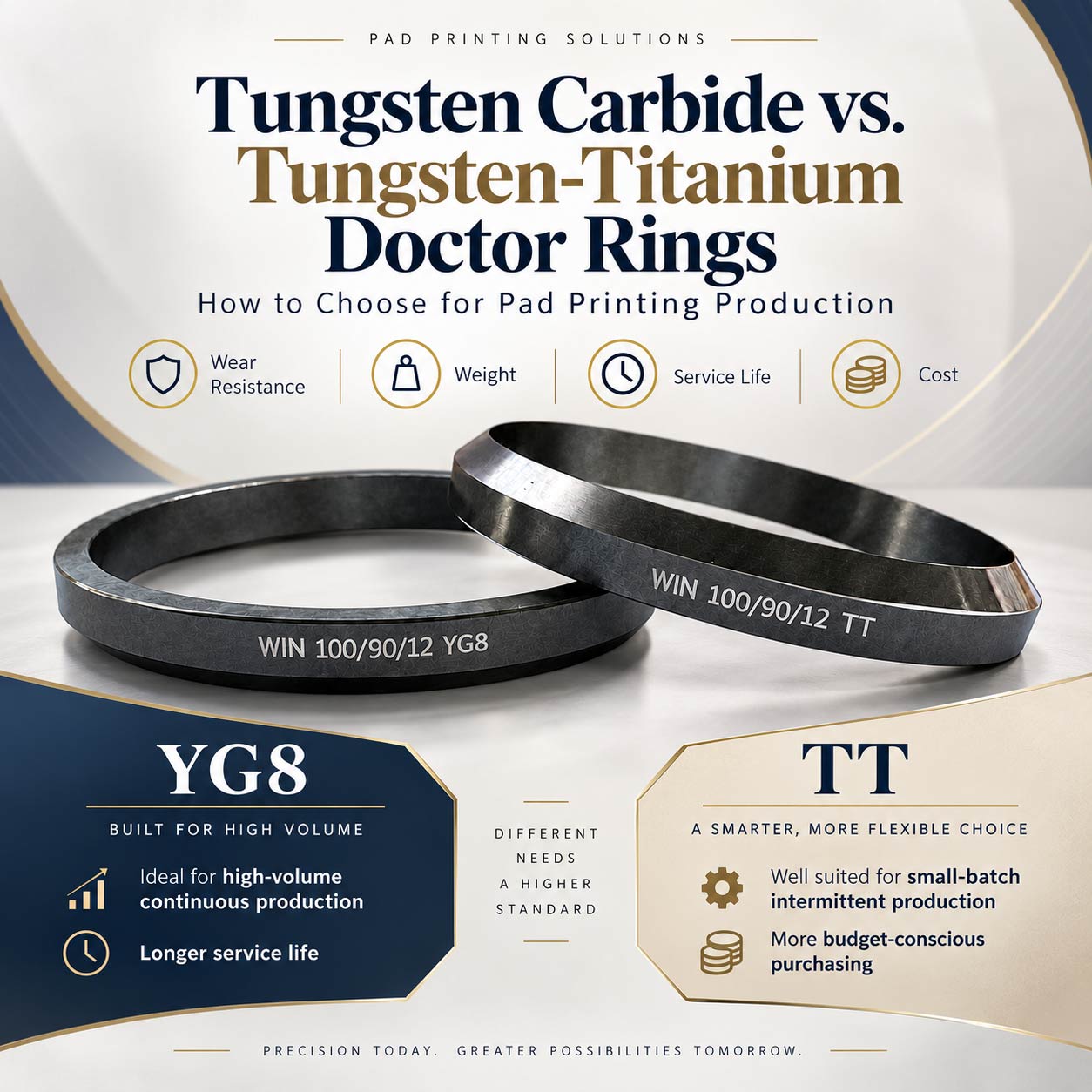
Different pad printing ring materials offer different levels of wear resistance, weight, service life, and cost.
For this reason, choosing a pad printing ring should not simply be about selecting the most expensive option. The better approach is to match the ring material with your production volume, operating frequency, application conditions, and cost requirements.
WINNEO currently offers two common alloy pad printing ring options:
YG8 Tungsten Carbide Ring
TT Tungsten-Titanium Ring
Although the two rings can have very similar dimensions and appearance, their material composition and application positioning are quite different.
1. Key Differences Between YG8 Tungsten Carbide and TT Tungsten-Titanium Rings
Using the WINNEO 100 × 90 × 12 mm test specification as an example, the differences between the two materials are relatively clear.
Item
YG8 Tungsten Carbide Ring
TT Tungsten-Titanium Ring
Model
YG8
TT
Test Size
100/90/12 mm
100/90/12 mm
Main Ingredients
WC 91%, Co 8%, Other 1%
WC 20%, TiC 60%, Co/Ni 18%
Scratch Resistance
≥300,000 cycles
≤200,000 cycles
Sample Weight
203.64 g
99.31 g
Price Positioning
More sensitive to tungsten material prices
More cost-friendly
Recommended Use
High-volume continuous production
Small-batch or intermittent production
It is important to note that:
Scratch-resistance cycles should be treated as reference data rather than a guaranteed service-life figure.
Actual pad printing ring life depends on many operating factors, including the condition of the printing plate, ink type, doctoring pressure, ink cup installation, machine setup, cleaning and maintenance practices, and the production environment.
Why Is the YG8 Tungsten Carbide Ring Much Heavier?
For the same 100/90/12 mm sample size:
YG8 Tungsten Carbide Ring:
203.64 g
TT Tungsten-Titanium Ring:
99.31 g
The difference is significant.
This does not come from a difference in ring dimensions. It mainly comes from the different densities of the materials.
The YG8 ring contains a high percentage of WC, or tungsten carbide, which has a relatively high density. As a result, a tungsten-carbide-rich ring tends to be considerably heavier at the same dimensions.
The TT ring contains a higher proportion of TiC, or titanium carbide, resulting in a lower overall material density and therefore a lighter ring.
In this case, product weight provides a simple and intuitive indication of the difference between the two alloy systems.
YG8 Tungsten Carbide Ring: Designed for Higher-Duty Production
The primary advantage of the YG8 tungsten carbide pad printing ring is its:
higher wear resistance and more stable performance during long-term operation.
WINNEO reference testing shows:
≥300,000 doctoring cycles
For factories operating pad printing equipment for long periods each day, replacing a pad printing ring involves more than just the cost of the consumable itself.
A ring replacement may also require:
Machine downtime
Ink cup removal
Ink cup cleaning
Pad printing ring replacement
Reinstallation
Contact adjustment between the ink cup and printing plate
Doctoring tests
Production restart
For high-volume manufacturing, longer and more stable pad printing ring life can therefore help reduce maintenance frequency and unplanned production interruptions.
YG8 is particularly suitable for:
High-volume continuous production
Ideal when pad printing machines operate for extended periods every day.
High-duty printing environments
Suitable for applications involving a large number of repeated doctoring cycles.
Factories looking to reduce ring replacement frequency
Although the initial purchase cost may be higher, longer service intervals can help improve the overall operating cost.
4. TT Tungsten-Titanium Ring: A More Cost-Oriented Alternative
Compared with YG8, the TT tungsten-titanium ring uses a lower proportion of tungsten carbide and a higher proportion of materials such as titanium carbide.
One direct result is:
a lighter pad printing ring with a more cost-friendly purchase price.
WINNEO's reference scratch-resistance figure is:
≤200,000 cycles
This means that under very intensive, continuous production, its wear resistance is generally lower than that of YG8.
However, not every pad printing application requires more than 300,000 doctoring cycles.
For example, some factories:
operate machines for only a few hours per day;
produce relatively small batches;
frequently change product models;
or mainly handle customized, short-run production.
In these situations, extremely long theoretical service life may not provide enough additional value to justify a higher initial material cost.
For these users, the TT ring can provide a more economical solution.
5. Why Do Tungsten Prices Affect YG8 Pad Printing Ring Prices?
Approximately 91% of the YG8 composition is WC tungsten carbide.
This means tungsten-related raw materials represent a significant part of the total material cost.
When market prices for tungsten, cobalt, or related materials fluctuate, the manufacturing cost of high-tungsten-content pad printing rings can also change.
As a result, customers may occasionally notice that the price of the same tungsten carbide ring specification changes between different purchasing periods.
This is not necessarily caused by machining costs alone. Raw material prices can be an important factor.
Because the TT ring uses a lower proportion of WC, it can provide a more flexible alternative when purchase cost is an important consideration.
6. How Should You Choose Between YG8 and TT?
If your production involves:
Long daily machine operating hours
High production volume
Continuous production runs
A strong need to reduce maintenance and ring replacement
then:
YG8 Tungsten Carbide Ring
is generally the more appropriate choice.
In these production environments, wear resistance and longer replacement intervals can be more important than the initial purchase price of a single pad printing ring.
If your production involves:
Small-batch orders
Intermittent production
Machines that do not operate continuously
Greater sensitivity to initial purchasing cost
Acceptable pad printing ring replacement frequency
then:
TT Tungsten-Titanium Ring
may provide a more economical solution.
7. Don’t Compare Purchase Price Alone—Consider Total Operating Cost
A common mistake when purchasing pad printing consumables is to compare only:
the price of one pad printing ring.
In real production, however, the total cost should include:
pad printing ring cost + replacement frequency + machine downtime + setup time + maintenance labor.
For example:
A less expensive ring that requires frequent replacement may not necessarily be cheaper over the long term.
On the other hand, if production volume is relatively low, purchasing the highest-wear-resistance ring may not provide enough additional economic value.
Therefore:
The most cost-effective pad printing ring is the one that matches your actual production needs.
8. What Else Affects Pad Printing Pad Printing Ring Life?
Material is only one factor affecting pad printing ring life.
Actual performance can also be influenced by:
Printing plate surface condition
Surface roughness, scratches, burrs, or abnormal plate wear can accelerate pad printing ring wear.
Contact between the ring and printing plate
Excessive ink cup pressure or uneven contact can lead to localized wear.
Ink and solvent systems
Different inks and solvents may influence the operating conditions of the sealed ink cup system.
Machine operating speed
Higher-speed continuous operation creates more doctoring cycles within the same period.
Installation and cleaning
Incorrect installation, removal, or cleaning methods may shorten the practical service life of the ring.
For this reason, even when two factories use exactly the same ring model, their actual service life can be quite different.
Conclusion: It’s Not About Which One Is Better—It’s About Which One Fits
YG8 tungsten carbide and TT tungsten-titanium pad printing rings should not simply be viewed as a “premium” and “basic” option.
A more accurate distinction is:
YG8: Wear Resistance First
Better suited to high-frequency, high-volume, continuous production where reducing ring replacement and machine downtime is important.
TT: Cost Flexibility First
Better suited to small-batch or intermittent production where initial purchase cost is a more important consideration.
The final choice should be based on your machine model, ink cup dimensions, production volume, daily operating hours, and maintenance requirements.
If you are unsure which material is suitable for your pad printing application, the selection can also be evaluated according to your existing ink cup size, pad printing ring dimensions, machine model, and production frequency.
Читать далее






 IPv6 ПОДДЕРЖИВАЕМАЯ СЕТЬ
Карта сайта
| XML | Блог | политика конфиденциальности
IPv6 ПОДДЕРЖИВАЕМАЯ СЕТЬ
Карта сайта
| XML | Блог | политика конфиденциальности
 Русский
 English
 Русский
 Italiano
 Español
 عربي
عربي 한국어
한국어 Türk
Türk Polski
 ไทย
ไทย Tiếng Việt